 Inside the Asset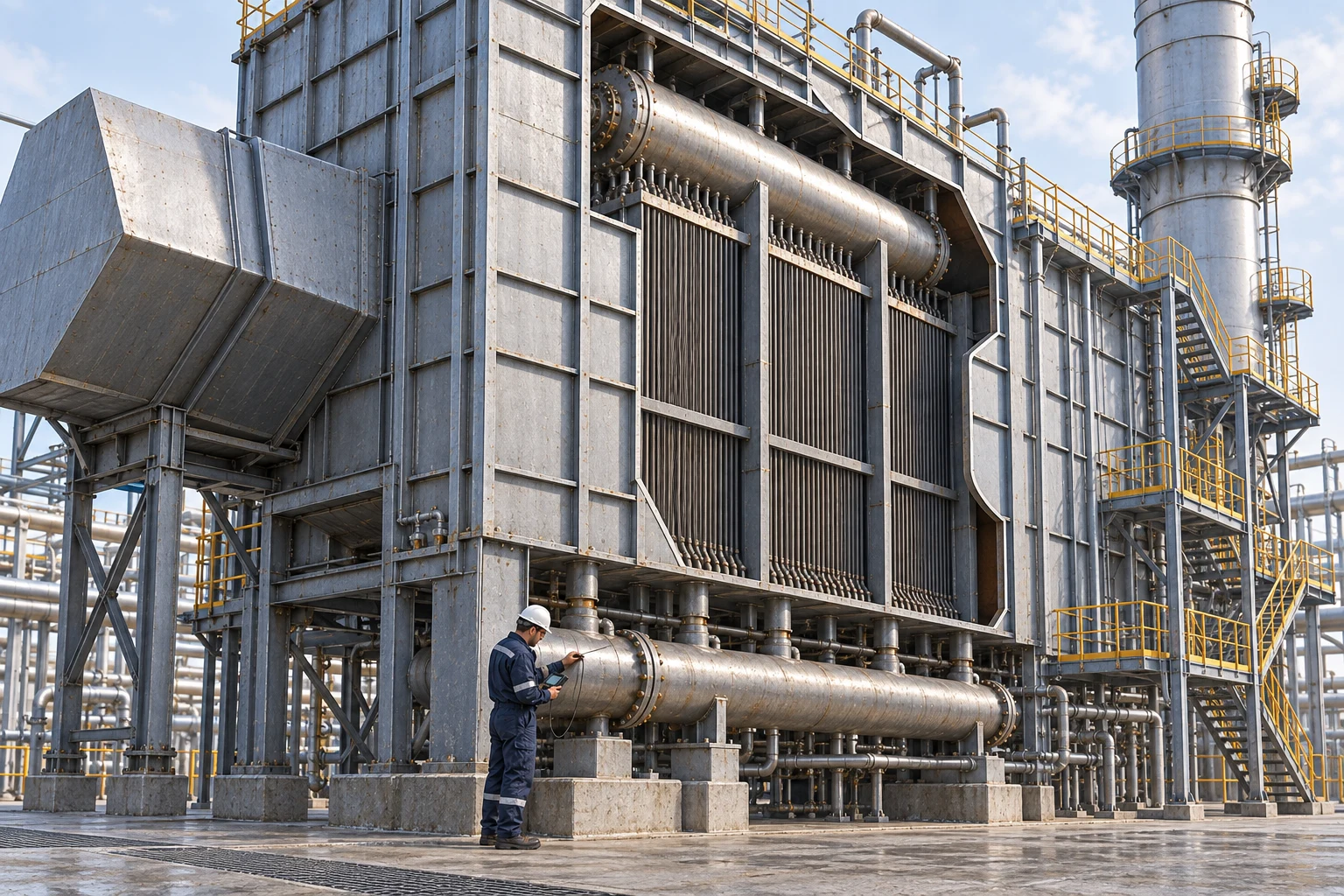
Ultrasonic thickness measurement on an accessible HRSG pressure part. AI-generated illustration; instrument appearance and geometry are illustrative.
What it is
A heat recovery steam generator, or HRSG, recovers heat from a hot gas stream, commonly gas-turbine exhaust, to produce steam. In a combined-cycle plant, that steam can supply a steam turbine; other installations use it for process duties. [1]
This guide illustrates a horizontal gas-path, drum-type HRSG. Multiple pressure levels, reheaters, duct burners and once-through designs change the arrangement. Use the plant drawings to identify the pressure circuit and tube bank before interpreting any numbered inspection location.
How it works
Gas path. Hot exhaust enters the inlet duct, passes the heat-transfer surfaces and exits toward the stack. Liners, seals and expansion joints help manage the hot-gas enclosure; their condition matters alongside the pressure parts. [1, 2]
Tube banks. Economizer sections heat feedwater, evaporator sections generate steam, and superheater sections raise steam temperature. Reheaters are present in some arrangements. Actual ordering and pressure levels must be read from the unit drawings. [1]
Drums and headers. In a drum-type circuit, the drum supports water-steam separation and circulation. Headers collect or distribute flow between tubes and connected piping. Tube-to-header locations need precise identification for repeat examinations.
Supports and auxiliaries. Hangers, guides and structural members accommodate weight and thermal movement. Drains, vents, level controls and attemperation equipment can influence reliability even when the largest tube banks appear normal. [2]
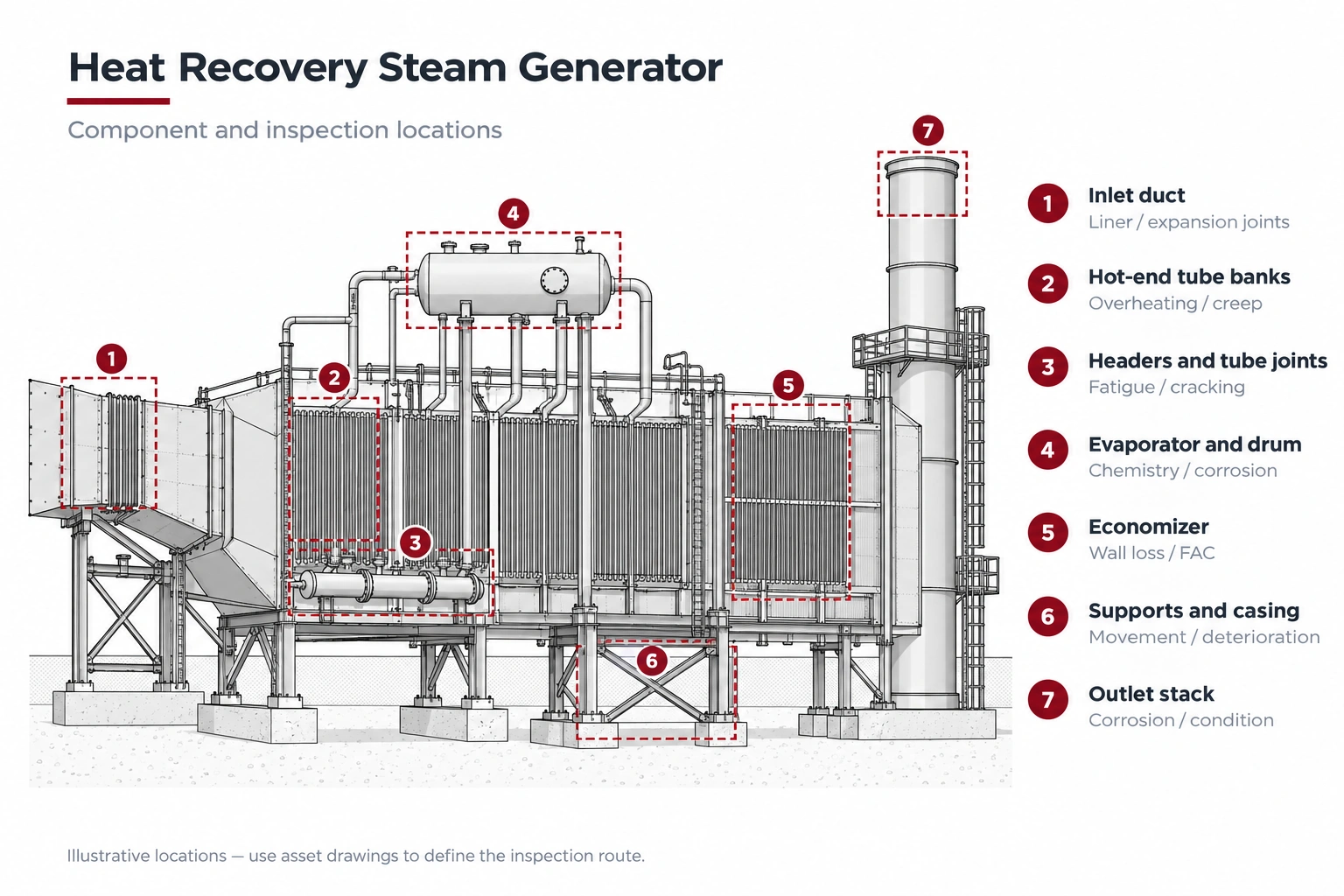
AI-generated component-location illustration, not to scale. Use the asset’s drawings and identifiers to localize findings; highlighted zones illustrate component areas and do not define complete examination coverage.
Where it fails
Tube and header connections. Thermal cycling and restrained movement can concentrate fatigue damage. Record the pressure circuit, row and joint location so an indication can be revisited during the outage. [2, 3]
Hot-end pressure parts. Sustained high-temperature service can require an assessment of overheating or creep-related damage. A spot wall-thickness reading alone does not establish remaining life; operating history and specialist evaluation matter. [4]
Water and steam circuits. Chemistry-related corrosion, deposits and flow-accelerated corrosion in susceptible regions require mechanism-specific investigation. Not every bank has the same risk or needs the same examination. [3]
Gas path, casing and supports. Damaged liners, expansion joints, supports or drains can affect heat distribution and movement. An exterior hot spot is an observation to investigate, not proof of the condition of the tube surface behind it. [2]
How it gets inspected
Divide the route by pressure circuit, tube bank and access zone. Bring previous leak locations, chemistry excursions, operating-cycle history and repair records into the plan. Specify how a finding will be located by row, elevation and tube number.
Combine gas-path and pressure-part examinations with operating evidence. Use the owner’s boiler program, OEM guidance and applicable requirements to define scope and acceptance. Different pressure parts and supporting structures require different assessment methods; remote imagery cannot establish the condition of hidden tube surfaces.
Equipment for the job
Choose the method for the question, then the instrument and configuration for the asset. The following options address different parts of the inspection.
Remote visual access. Industrial videoscopes can document reachable headers, joints and confined views. A suitable drone may support larger accessible gas-path spaces during a prepared outage, but dense tube banks and obstructions limit visibility. Record the side of the bank examined and the surfaces that remain hidden. An Evident IPLEX GT is an option where probe reach and access suit the task.
Thickness examination. UT gauges and appropriate mapping systems can assess accessible pressure parts. Select the probe, calibration and measurement arrangement for the surface and expected loss. Finning, curvature and restricted access can prevent reliable readings; do not treat an inaccessible location as measured. An Olympus 38DL Plus is an example for accessible wall-thickness measurements with the appropriate transducer.
Targeted crack examination. Qualified providers select suitable surface or ultrasonic methods for suspected cracking at headers, welds and other critical locations. Access, geometry, temperature and the expected damage determine technique suitability. The report should distinguish detection from characterization and engineering disposition. An Olympus EPOCH 650 is an option when the selected procedure calls for conventional ultrasonic examination.
Metallurgical assessment. Where overheating, creep or repeated tube failure is suspected, specialist work may include material examination, sampling or failure analysis. Correlate it with operating history and the exact tube location. An estimate of remaining life requires more than an external image. [2]
Thermal surveys. A thermal camera can help find abnormal exterior temperature patterns and guide follow-up. Insulation, loading and viewing conditions affect the apparent result. It does not measure remaining wall thickness behind casing or establish the condition of every internal bank. A FLIR T540 can support accessible exterior surface-temperature comparisons.
Chemistry and performance evidence. Review water-steam chemistry, temperature/pressure history, leak records and operating changes with the owner. These records help prioritize the examination and investigate recurring failures; they do not eliminate the need to inspect the affected material. [3]
Field note
An HRSG inspection map should separate examined surfaces, screening indications and specialist follow-up. Tube-bank visibility is rarely the same as full pressure-part coverage.
Why it matters
An HRSG connects gas-turbine operation, steam production and the water-steam cycle. Finding the damaged tube is only one part of the work; understanding why it failed helps avoid repeating the same repair in the next operating period.
Ask your inspection provider
How will you identify each inspected tube bank and pressure circuit, quantify the access gaps, and connect any recurring failure to cycling, chemistry or mechanical restraint?
Field card - record on every route
Identify. Unit, pressure level, circuit, bank, row, tube and elevation references; relevant repair and leak history.
Record. Operating/outage state, access side, examination method, surface condition, settings and finding reference.
Confirm. Connect suspect areas to direct examination, material review or other targeted follow-up.
Flag gaps. Hidden tube surfaces, fin-obscured regions, blocked lanes, unexamined joints and missing history.
Close the loop. Repair location, root-cause action, owner, review authority and updated unit drawing or inspection map.
Support for the inspection
Coordinate access preparation, cleaning, examination sequencing and technical review before the outage. Involve the owner’s boiler and chemistry specialists when selecting follow-up. MFE can support appropriate inspection instruments and training; boiler engineering and repair acceptance remain separate responsibilities.
Sources and equipment references
1. GE Vernova - HRSG designs and services
2. GE Vernova - HRSG inspections and failure analysis
3. Structural Integrity - HRSG and boiler assessment
4. Babcock Power - HRSG design for cycling operations
Educational guide by Jason Acerbi, an executive at MFE Inspection Solutions. These guides do not replace asset-specific procedures or engineering assessment. Named instruments are examples, not a claim that MFE supplies every diagnostic service or stocks every configuration. Confirm suitability and availability for the planned task.